

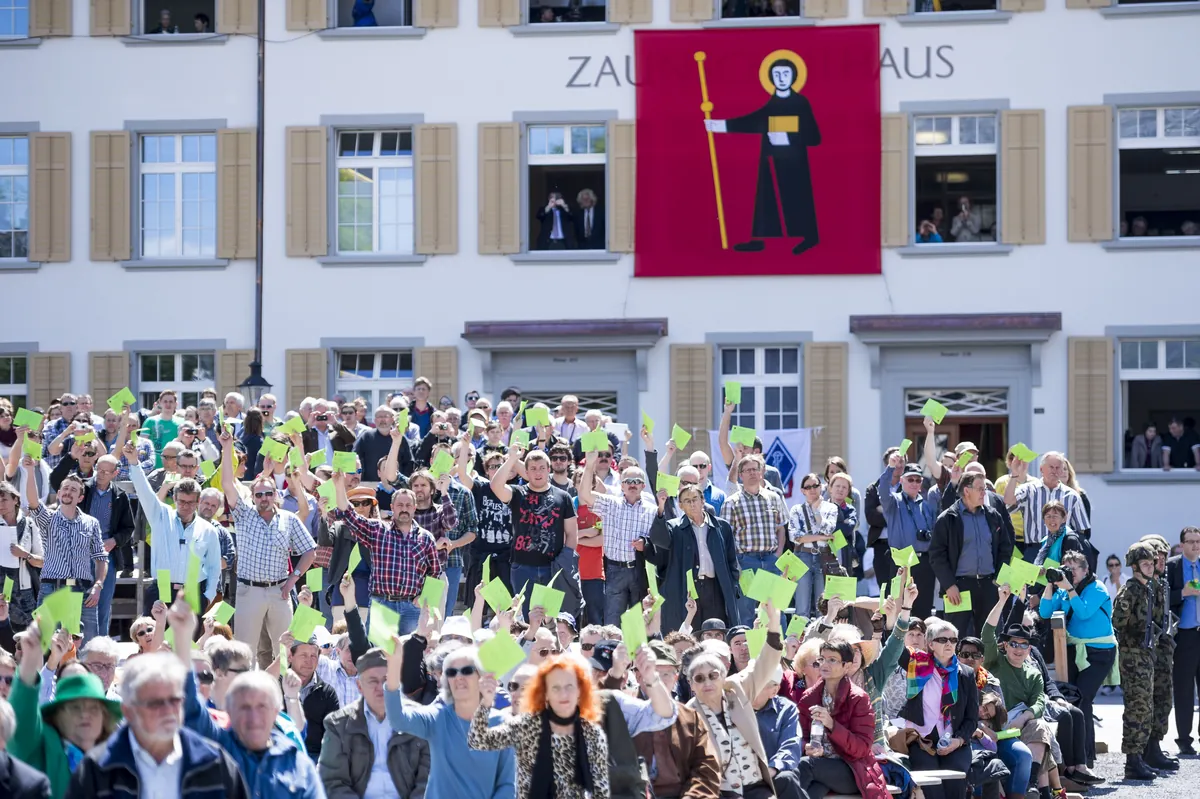

When women first voted at the cantonal assembly in Glarus in 1972, there was a job for the carpenters. The year before, the men entitled to vote had approved full voting rights for women in the canton. Now everyone needed a place to stand. To make more room, the carpenters rebuilt the assembly ring as an oval.1
On the first Sunday in May, the Zaunplatz in the Swiss town of Glarus hosts the Landsgemeinde. Spectators have stands of their own. In the ring, eligible voters can address the assembly, propose an amendment and raise their voting cards to decide matters ranging from laws to taxes. The assembly in Glarus dates back to 1387. Only two Swiss cantons still hold one at cantonal level, Glarus and Appenzell Innerrhoden.23
The fourth speaker had a different map
In May 2006 the government and parliament of Glarus put a plan to the square. They wanted to merge twenty-five municipalities into ten. Kurt Reifler, from Ennenda, was the fourth of fourteen people to speak. He proposed cutting the number to three. He was willing to put his own town into a new municipality that would include the town of Glarus.456
Reifler argued that the three would be roughly equal in population. Each could deal with the others without a bigger neighbour dominating. The government had already costed this option, so he could draw on its own figures to make his case. His amendment carried. The three municipalities began work on 1 January 2011. The merger meant bringing water supplies, fire services and schools under the new authorities. Anyone arriving at the square with a settled opinion about the ten-municipality plan had been given considerably more to think about.456
When the chair needed four more pairs of eyes
On 6 May 2007 the question was whether Swiss citizens living in the canton should be allowed to vote in cantonal and municipal matters from the age of sixteen. Walter Lacher, who chaired the parliamentary committee, argued for keeping the voting age in step with legal adulthood. Marianne Dürst, speaking for the cantonal government, saw a chance to put school civics lessons to use while they were still fresh. At one point the weather prompted the chair, Robert Marti, to ask speakers to keep it short. The sixteen-year-olds whose rights were at stake had no cards to raise that morning.78
At a Landsgemeinde the chair judges the majority by eye. It took three shows of voting cards that day. For the third, Marti called on the four other members of the cantonal government to help him judge the result. Sixteen-year-olds won the vote. The record gives the ruling and leaves the margin unnumbered. From a spot in the ring, you might have been more certain of your neighbour’s vote than of the outcome for the canton.278
Who feels comfortable turning up?
In April and May 2016, just over a thousand Glarus residents took part in an online survey by the University of Bern. Only 1 per cent said they often or always felt pressure to vote a particular way at the assembly. Politically interested residents and party members were overrepresented. What any one voter would do on the very same issue in the privacy of a booth remains an open question.9
Who turns up may say more. At the 2015 assembly, the chance that someone attended was closely linked to how embedded they were: how often they spoke to their neighbours and how many friends and family they had in Glarus. The neighbour question starts before a single card goes up. From the stands, you only see the people who came.9
There is also something to be gained from hearing the person whose vote cancels out your own. On each of two measures debated in 2016, more than six in ten respondents said they heard an argument at the assembly that was new to them. One concerned fathers employed by the canton. Should they get two days off after the birth of a child, or five? The assembly chose five.9
A time limit for the person at the microphone
At the assembly on 3 May 2026, Thomas Vögeli of Oberurnen made the case for taking his proposal on speaking time further. Three minutes per speaker seemed plenty to him. He even suggested an audible warning when time was nearly up. The voters declined to take the proposal any further.10
Had you stood beside Vögeli, he could have watched you vote. Whether you minded the long speeches, disliked the idea of a buzzer or simply wanted to hear someone finish a thought was something he would still have had to ask you afterwards.
More from Marnival: Switzerland.
Sources and notes
- Staatskanzlei Kanton Glarus, Wir sind Landsgemeinde: Ring frei für die Frauen. Votes for women and the oval ring. In German. ↩
- Canton of Glarus, Landsgemeinde and general information: place, time and access to the ring. In German. ↩
- Historical Dictionary of Switzerland, Landsgemeinde. Glarus since 1387; two cantons still hold one. In German. ↩
- Staatskanzlei Kanton Glarus, minutes of 7 May 2006, item 13 (PDF). Kurt Reifler’s amendment. In German. ↩
- Canton of Glarus, Memorial for the extraordinary assembly of November 2007 (PDF, § 1.2.2). The speakers and the three-municipality option in 2006. In German. ↩
- Canton of Glarus, Chronik einer Strukturreform. From the 2006 proposals to the start in 2011. In German. ↩
- Staatskanzlei Kanton Glarus, minutes of 6 May 2007, item 7 (PDF). Contributions by Lacher and Dürst, the request for short speeches and the three rounds of voting. In German. ↩
- Canton of Glarus, Landsgemeinde of 6 May 2007; SWI swissinfo.ch, report on the vote. In German. ↩
- University of Bern, Institute of Political Science, Forschungsbericht Landsgemeinde Glarus (PDF). The 2016 survey: social pressure, attendance and new arguments. In German. ↩
- Canton of Glarus, record of 3 May 2026, item 13. Thomas Vögeli’s proposal. In German. ↩
Last checked: .